
Like Sabra, Beni Mrirt Rugs Don't Really Exist Either
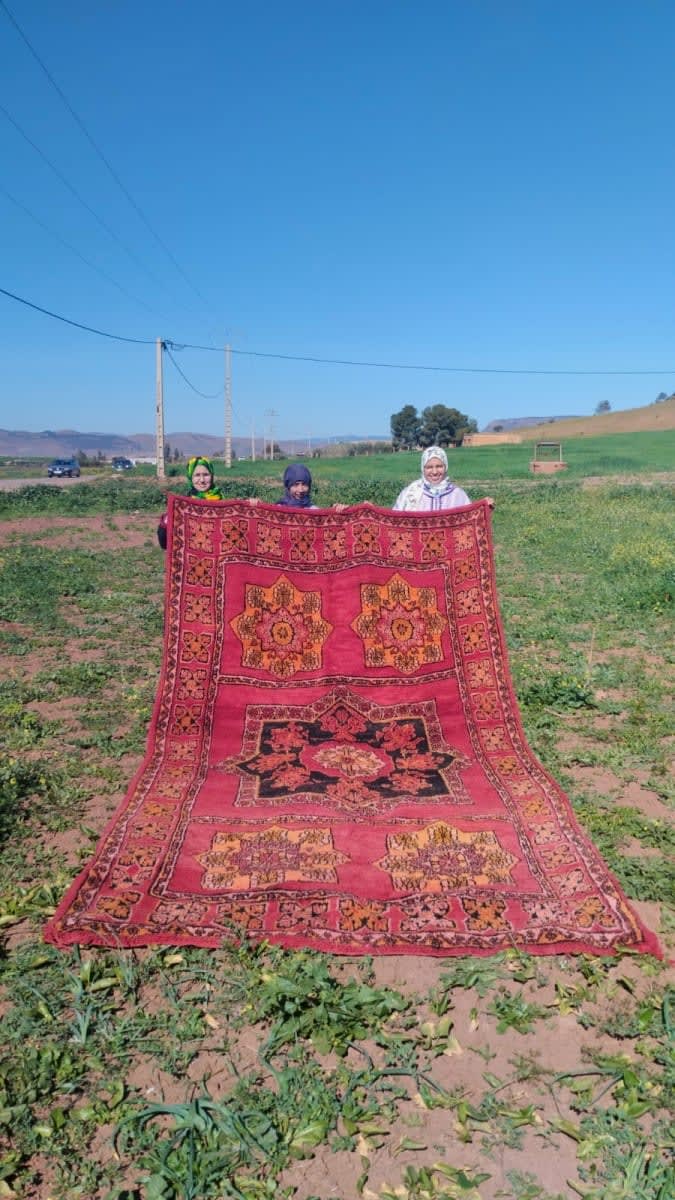
The first email we ever got from a customer asking about a "Beni Mrirt" rug arrived in September 2019. It came as a screenshot from an Etsy listing. We hadn't heard the term before. Six years later, it's one of the most common rug terms in our inbox.
We can tell you why. Beni Mrirt rugs are not a tribal tradition. They're a marketplace label invented by middlemen, popularized on Etsy in the years after Etsy stopped being about handmade work, and applied retroactively to whatever rug a seller wants to charge a premium for. As with our post on vintage rugs and our post on sabra, this is yet another simple fact you can use to determine whether the person selling you a "Beni Mrirt" is being honest about what they do.
What's real
The first place to start is with people who are actually from there. Rachida Ousbigh — Anou artisan leader, current president of The Anou Cooperative, and founder of Cooperative Tiglmamin in the Middle Atlas — is unambiguous: the region around Khénifra and M'rirt is Zayan tribal territory. The traditional weaving from that region is Zayan weaving, and historically, Zayan rugs were known for their heavy use of red. The technique was largely consistent across the region, and the identity sat with the tribe and the village — not with whichever market town happened to be nearest.

That matches what's in the historical record. Britannica's entry on Khénifra describes the area as the wintering ground of the Aït Affi, a Zayan branch. The 1994 Pickering, Pickering & Yohe survey Moroccan Carpets, published by Hali, is a commonly cited English-language reference on Moroccan rug traditions. It indexes the Khénifra region under Zayan-area tribal names — Aït Youssi, M'Guild — alongside the rest of the standard Moroccan rug taxonomy. There is no entry for "Beni Mrirt" in that book, just as there is no Beni Mrirt entry in Wikipedia's catalogue of Berber tribes, in Britannica, or in any of the academic literature on Middle Atlas Amazigh communities. If a "Beni Mrirt" tradition existed, existing research would have easily turned it up.
"Beni Mrirt" Is a Recently Invented Term
The "Beni" prefix in Arabic means "children of," and it normally precedes a tribal name — Beni Mguild, Beni Ouarain, Beni Hilal. In "Beni Mrirt," the prefix has been bolted onto the name of a town to fabricate something that sounds like a tribal designation. That's the whole trick.
M'rirt itself is real enough as a place. It's a town of about 35,000 in Khénifra Province, historically a mining town for lead, zinc, and silver, today mostly agricultural with a well-attended weekly souk. But in artisan circles, M'rirt has a reputation that the marketing copy avoids: along with Khénifra more broadly, it has become one of Morocco's primary middleman trading hubs for rugs. It is a place where rugs are bought from weavers at low prices, dirt-aged, washed, and rebranded — not a place where artisans run their own businesses and sell directly. Naming a rug after M'rirt, in 2026, is a little like naming a wine after the wholesaler's warehouse rather than the vineyard.
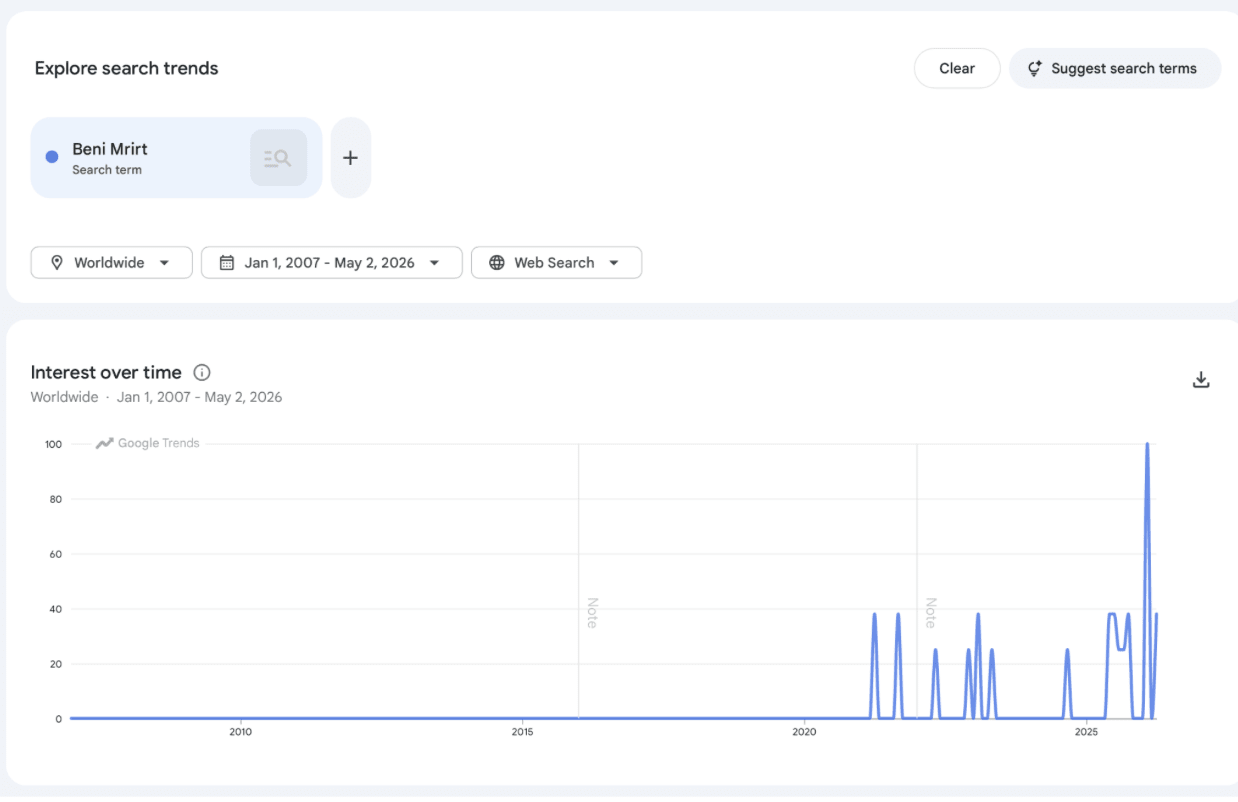
A simple Google Trends query for "Beni Mrirt" makes the pattern obvious. The term essentially does not exist in global search data before 2019*. The genuine, sustained signal — the curve climbing steadily upward — begins in 2019–2020 and continues through today.

We can corroborate that on our own end. After that first September 2019 email, we didn't get another for nearly two years. By 2022 the term was appearing regularly. By 2024 and 2025 it had become one of the most common rug terms in our inbox, often alongside variant spellings ("Mrirt," "Merirt," "Mirirt") that customers had clearly copied from listings without quite knowing what to call them.
Why 2019? Etsy stopped being Etsy
The timeline of Beni Mrirt's rise tracks closely to the years in which Etsy completed a transformation from a small handmade marketplace into a generic e-commerce platform. The seeds were planted in 2013, when Etsy quietly rewrote its rules to allow sellers to use outside manufacturers — a policy that was criticised at the time for diluting the platform's handmade ethos. The IPO followed in April 2015. By 2017, an activist investor pushed out the founder-aligned leadership and installed a new CEO whose mandate was growth and profitability above all else. From that point on, Etsy was a general marketplace dressed in handmade language, not a handmade marketplace. The distinction matters because once authenticity stops being enforced, invented heritage stops being a liability and becomes an asset.
We're speculating here, but we suspect the "Beni Ourain" label had already been thoroughly commoditised on this version of Etsy by 2018, to the point where it commanded almost no premium. A new tier was needed for a newer wave of middlemen originating from outside Marrakesh — a name that sounded equally tribal and authoritative but felt scarcer, more refined, more luxurious and indirectly reflected the new Khenifra-based sellers on Etsy. M'rirt sat conveniently next door to the actual middleman trading hub. When dealing with middlemen, things are always from the next village over, or the next town over. Wherever is just too far away for inquisitive minds to actually go to. M'rirt fits and the "Beni" prefix was lying around. The two were welded together, and Beni Mrirt was born as a category. One reseller site we found while researching this post even calls Mrirt rugs "the new Beni Ourain" outright, which is more honest than most of what's out there.
The first sites pushing Beni Mrirt as a premium tier launched right at the inflection point. OunizZ states that it launched in Marrakech at the end of 2019. Other reseller sites followed quickly. By 2021 or 2022, every Etsy seller with a "Beni Ourain" listing also had a "Beni Mrirt" listing, usually at a higher price.
The Truth Is In the Contradictions
If "Beni Mrirt" were a real tradition, you would expect some baseline agreement on its core attributes — the way there is for Zayan, Beni Mguild, Beni Ouarain, or Azilal weaving. There isn't. Walk across reseller sites and you'll find that every supposedly fundamental fact about Beni Mrirt contradicts the next site over, and sometimes contradicts itself within a single page. Here is a sample, all from sites currently selling "Beni Mrirt" rugs:
On the wool: This is the most telling one. Benisouk's product pages describe the wool in their "Beni Mrirt" rugs as "100% prestigious New Zealand wool" in one paragraph and "wool imported from Australia" in the next, on the same product page. A different Benisouk product describes "a luxurious blend of premium New Zealand wool and high-quality Moroccan wool, a combination we've innovatively refined." Studio Lid, meanwhile, says the wool comes from a "Marmoucha breed" of sheep, which is not a real thing — Marmoucha is a tribe, not a sheep breed, and there are sheep in the area as there are sheep almost everywhere in rural Morocco. MRIRT.com says the wool comes from Beni Guil sheep. Setting aside which of these is true, none of them can be true at the same time. And it's worth pausing on Benisouk specifically: rugs marketed as the heritage of an "ancient tribe" are openly being woven from wool imported from the southern hemisphere. That is not a Moroccan tribal tradition. That is a contemporary product line wearing tribal language.
On location: Casa Amar places Beni Mrirt in the Middle Atlas in one paragraph of its rug guide and the High Atlas in another. Studio Lid says they are "isolated in the north-east of the Middle Atlas." Tigmi Trading places them "higher up the Middle Atlas Mountains." Berber Creations just says "the heart of Morocco's Atlas Mountains." M'rirt is, in fact, in the central Middle Atlas, conveniently found on Google Maps.
On look and feel: Tigmi Trading says "Beni M'Rirt carpets are known for their darker, bolder colours" and that "earlier versions feature only variegated colour without any pattern." Boholab says they are "typically colorful, with vibrant reds, blues, and yellows." Atelier Beni says they are "bold, rich, luxurious, and unapologetically deep." Casa Amar says they were historically "minimalist and essential designs, geometric figures." Benisouk emphasises softness and shag pile. These cannot all be true of the same rug tradition. And none of them lead with red, which is what the weaving of this region — Zayan weaving — was historically known for.
On age and origin: Boholab claims "the earliest known examples of Beni Mrirt rugs date back to the 16th century" — a remarkable historical claim that, if true, would be supported by a museum collection or an academic citation. None is offered, and no other reseller site repeats it. Tigmi Trading invokes "the Beni M'Rirt tribes" as a real entity. 1stDibs lists "the Beni Mrirt tribe" as if catalogued. Okre Shop calls them "undoubtedly one of the best [tribes] that have managed to preserve their techniques." There is no such tribe. The Khénifra region is Zayan territory, and has been documented as such in the historical record for over a century.
On what makes them special: Berber Creations attributes the reputation to a precise knot count of "15 to 18 KPSI" versus 6–8 for Beni Ourain — a level of specificity offered nowhere else. Casa Amar attributes it to a "secret" washing process that "few know how to" perform — a claim that sits comfortably alongside the bleach-and-blowtorch toolkit we documented in our vintage rugs post. Benisouk attributes it to "noble rug" status and imported wool. OunizZ uses the "Noble Rug" framing too. Each of these is a different story about what the category fundamentally is.
Compare this to how the same kind of seller talks about Beni Ourain. Beni Ourain rugs were a real thing. The tribal confederation existed, the wool came from a documented region, the visual language was consistent enough that you can pick a Beni Ourain out of a lineup. So even on reseller sites, there's broad consensus on what a Beni Ourain is — neutral ground, dark geometric lines, undyed wool, Middle Atlas. You can argue about quality and provenance, but not about what the category is.
Why we don't use Beni Mrirt at Anou
Our long-running view at Anou is that the answer to fantastical names is not to invent better ones. It's to ground the work in the actual people and places that made it. Our goal is for every cooperative to develop an identity rooted in their own place, environment, and culture — because that is how a robust and varied artisan economy is actually built.
Funneling production into a handful of prescribed labels does the opposite, and it is not a new idea. It echoes the approach of the French Protectorate, whose craft administration reorganized Moroccan workshops around standardized motifs and pattern books built for European markets — collapsing centuries of distinct, local traditions into a narrow, legible set of exportable products. A century later, the marketplace label does the same work by other means: it flattens the real diversity of Moroccan weaving into a few sellable buckets, and the wider community — with all its specific villages, techniques, and histories — is left materially worse off for it. There is a grim irony in this. The Zayan fought the French to a standstill in the Middle Atlas a century ago; what colonial administration couldn't accomplish by force, the marketplace — led by Moroccan middlemen and foreign Instagram brands — is now finishing by label. (To learn more about the colonial roots of how Moroccan craft was categorized, see: Of texts and textiles: colonial ethnography and contemporary Moroccan material heritage, Art in the Service of Colonialism: French Art Education in Morocco, 1912–1956, and Colonial Urban Planning and the Aestheticization of Morocco Under the French Protectorate.)
So when we describe a rug, we describe the artisans and the group that made it. The cooperative's name. The village. The region. The name of each weaver. That's the information that should travel with a rug — not only because it lets a buyer reward the right person, but because rewarding the right person is the only arrangement that actually keeps craft alive. Craft is not a static thing to be preserved under glass; it is a living practice, and it only stays living when the people doing it have room to move. An artisan who is properly compensated has the time and security to reflect on their work, to experiment, and to push their tradition somewhere new — rather than abandon it, or end up weaving on a production line for some middleman. Get the incentives right and the tradition has a reason not just to survive but to evolve. Get them wrong and no amount of heritage language will save it.
None of this means tribal identity doesn't matter. It does — it is a real and meaningful part of who many artisans are, and in some cases it still plays an important role in Moroccan life, heritage, and design. But it has to be applied truthfully, to the people it actually belongs to, not bolted onto a product for search rankings. A tribal label detached from any real maker is just marketing. And a fabricated one like Beni Mrirt is worse still: it doesn't merely obscure the person who wove the rug, it writes over people who are alive right now — erasing their identity and their potential — and it does so for a short-term gain that flows to someone other than them.
A way forward
Figuring out what a Moroccan rug actually is can be genuinely hard. Provenance is murky, the history is layered and sparsely documented, and even people who care deeply get things wrong. A lot of these questions don't have clean answers.
Beni Mrirt is not one of those hard cases. It's one of the easy ones. There is no tribe, no tradition, no consistent description, and no presence in the record before 2019. A seller listing rugs under that label has either not done the work to find out what they're actually selling, or has done the work and decided the invented name sells better. Neither is reassuring. If someone can't get the name of the thing right — the single most basic fact about a rug — it's worth asking what else they haven't bothered to get right: who made it, what they were paid, what's actually in the wool.
With Anou, we are working to make it as easy as possible for you to know the maker of each product on the marketplace, learn how to make the product through our workshops and residencies, and visit these people in the villages in which they live through our experiences. And through the Atlas Wool Supply Co., that traceability now runs all the way down to the wool itself — to the specific Atlas breeds it came from, the mountains where those sheep live and graze, and dyes that are non-toxic and solar-processed. The story that travels with the rug is the true one, because there's a real one to tell.
If you would like to buy a wool rug from a real cooperative, with real names attached, you can find Anou's groups at theanou.com/themarketplace.
Plan Your Own Visit
Find an artisan group near your route and schedule a visit — share tea, watch the artisans at work, and see the craft up close.
Explore Experiences